
Smart home platforms have spent the better part of two years promising that AI would make device management feel effortless. The reality, for most users, has been a messier story: mislabeled camera alerts, fragmented voice commands, and friction-heavy interfaces that required more patience than any ambient technology should demand. Google Home has been no exception.
On May 5, 2026, Google announced what it describes as the biggest update to Google Home since its AI-fueled redesign late last year. The update touches three distinct areas: voice intelligence, camera navigation, and home automation triggers. Early access users were already receiving the rollout at time of announcement.
The Tool
Google Home is the company's smart home platform, spanning a dedicated mobile app, smart speakers, Nest cameras, and a web interface. It received a major structural overhaul in late 2025 that introduced Gemini as its core AI layer. This May 2026 update builds on that foundation rather than replacing it, targeting the gaps that frustrated users since the original revamp shipped.
How It Works
The centerpiece of the update is the move to Gemini 3.1 for Home's voice assistant. Google first released Gemini 3.1 on other platforms in February 2026, but that rollout did not include smart speakers. The expansion to Home brings what Google describes as advanced reasoning for multi-step voice commands, meaning users can bundle multiple tasks into a single prompt rather than issuing them sequentially. Google has cited performance gains on evaluations including ARC-AGI-2 and Humanity's Last Exam, both of which test complex logic requiring domain-specific knowledge. The camera analysis model, however, is not being upgraded to Gemini 3.1; that improvement applies only to the voice layer.
Where It Fits: Four Use Cases Worth Knowing
Multi-Step Voice Automation
The Gemini 3.1 upgrade is most relevant for users who manage complex routines. Previously, executing a sequence of commands meant breaking them into separate requests. The updated model processes multiple tasks in a single prompt. For agencies running smart office environments or connected event spaces, this reduces the interaction overhead on shared devices.
Camera Timeline Navigation
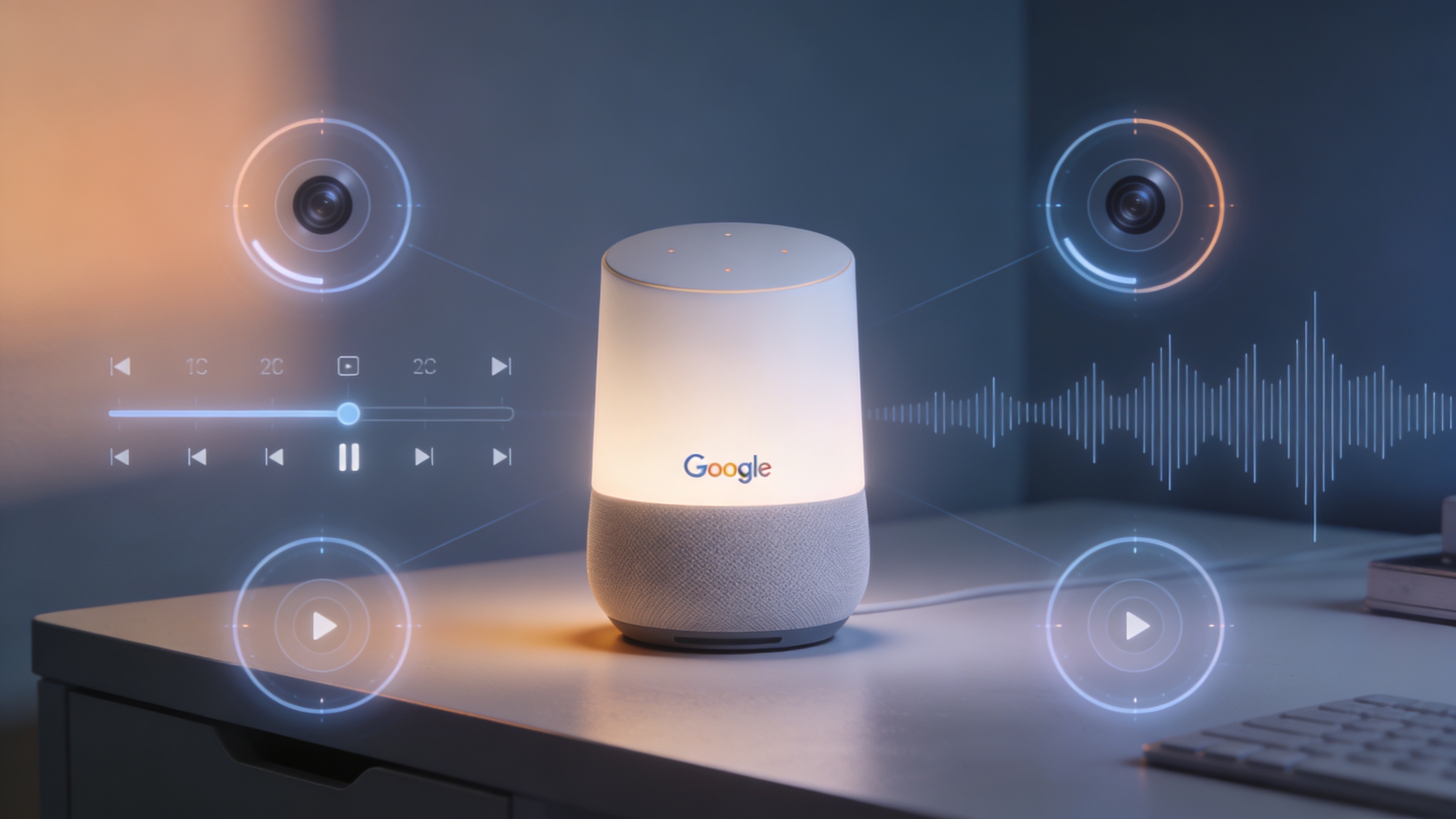
The 2025 app redesign left camera control feeling clunky. This update adds a higher frame rate when scrubbing through video timelines, plus skip buttons that jump 10 seconds forward or backward. New swipe controls let users switch between timeline and event views and resize the player window. These are small changes, but they address one of the most-cited friction points in the existing interface.
Familiar Faces and Notification Accuracy
Google Home's shift to Gemini degraded its ability to recognise people in camera footage, making push notifications less useful. The update adds thumbs-up and thumbs-down feedback buttons on Familiar Face notifications, feeding corrections back into the model over time. The system will also automatically discard blurry or obscured images before attempting identification. Animated preview GIFs in notifications are being recentered on the detected subject.
Expanded Automation Triggers
The update adds a significant range of new automation ingredients across five categories: security and access control (including arm/disarm states and binary sensors for leak or freeze detection), appliance and cleaning (washer, dryer, coffee machine states, plus robot vacuum dock and pause commands), lighting and environment (brightness, colour temperature, blind position percentage, humidity monitoring), media and entertainment (playback and volume states), and device health (battery levels and smart switch input types including long press and release). Paying subscribers can use the Ask Home AI chatbot to build automations from these new triggers; free users access them through manual menus.
Limitations
Several constraints are worth flagging for anyone evaluating this update against real workflow needs. The Gemini 3.1 upgrade covers only the voice assistant; camera footage analysis stays on the previous model. Ask Home, the conversational AI feature, remains paywalled for automation creation and is only now arriving in the web interface as a preview. AI event descriptions, including the reportedly simplified labels designed to reduce mislabelling, require Gemini for Home to be manually enabled in camera settings and are not available on the free tier. Google itself acknowledges that past promises of improved AI accuracy have not always delivered, noting the system has a history of producing misleading labels.
Verdict
This update is a targeted repair job rather than a reinvention. The Gemini 3.1 voice upgrade and the 10-second skip buttons solve genuinely annoying problems, and the expanded automation library gives power users more to work with. Whether the AI label improvements actually reduce noise in practice remains unproven. For creative and production teams using smart office setups, the multi-step voice command capability and new device trigger options may reduce daily friction in meaningful ways. If Google's track record on AI accuracy in Home improves with Gemini 3.1, the platform could start living up to the ambitions of its 2025 redesign.