
The friction between AI-generated visuals and local community identity has mostly played out in abstract debates online. But in Santa Cruz, California, it landed on a single restaurant's doorstep in the form of one-star reviews, a deleted logo, and a business owner describing a crushed dream in a public Instagram post.
This is not a story about a corporation deploying AI at scale. It is a story about what brand signals actually communicate to a local audience — and how quickly those signals can override everything else a business is trying to say.
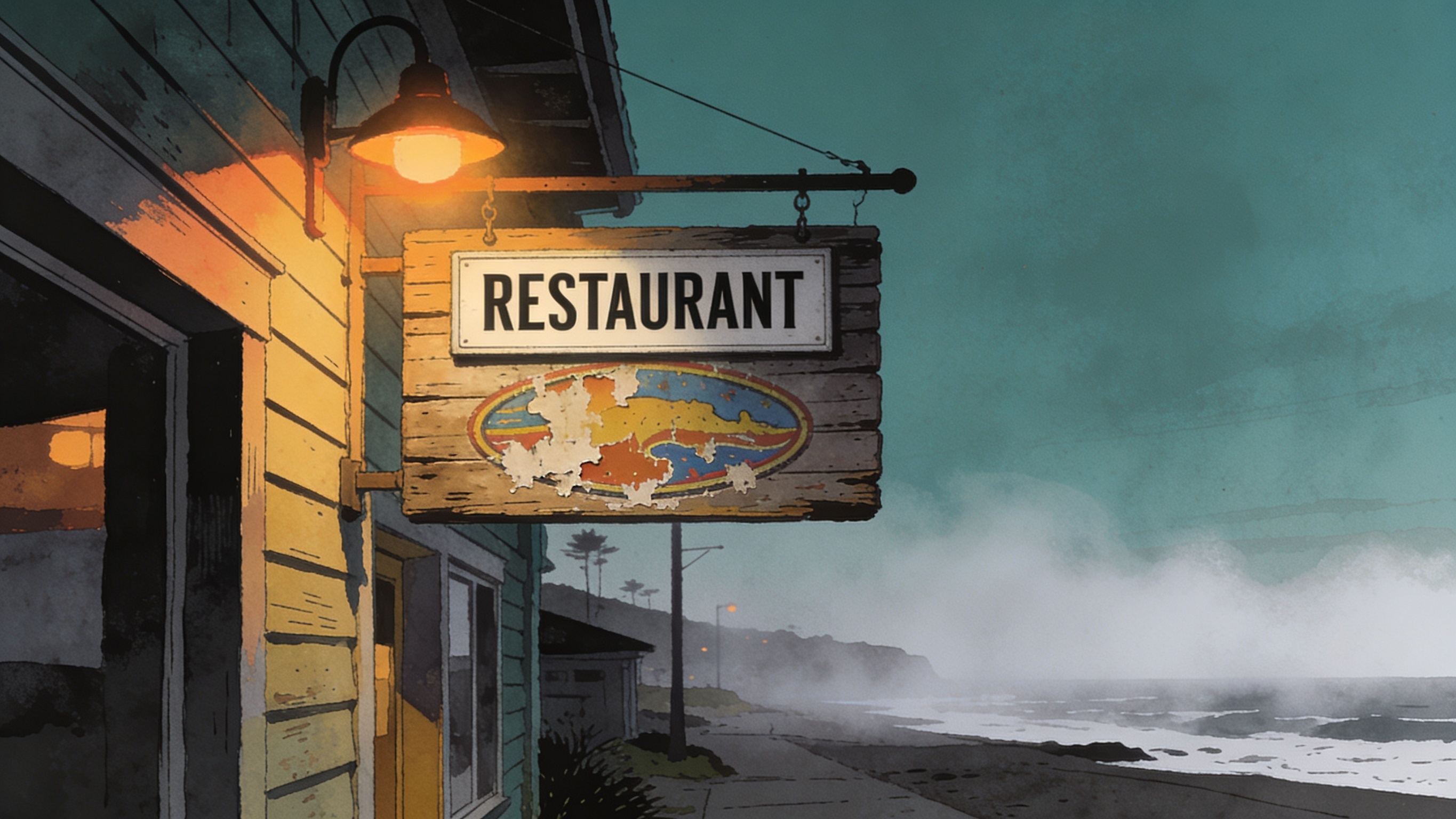
The Salty Otter, a restaurant and sports bar that opened last March at 110 Walnut Ave. in downtown Santa Cruz, built its early visual identity around a colorful logo of an otter on a surfboard. Owner Rachael Smith, who has 26 years of experience in computer graphic art, used AI tools within Canva to help create it — and put around 20 hours of her own work into the final result. Last week, after a wave of negative reviews on Google and Yelp criticizing the logo as AI-generated, Smith replaced it entirely with plain white text on a black background.
In a lengthy Instagram post, Smith described receiving one-star reviews from people demanding the return of 99 Bottles, the beloved pub that had occupied the same space for 28 years before closing in 2020, and criticizing her for not commissioning a local artist. Smith told SFGATE she received numerous one-star reviews on both platforms, though many have since been removed. One remaining Google review reads: "Their logo is AI generated, if they can't make the effort to create a logo they definitely won't make the effort to cook good food." A Yelp review called the image "AI slop" that "screams cheap."
A Practical Tool, a Political Signal
Smith's reasoning for using Canva with AI assistance was straightforward: efficiency and cost. She said the platform "cuts your work time in half when you're having to pump out advertising and marketing for your business" and that outsourcing was something she could not afford. For a new business trying to stay open, these are real constraints. The problem is that a logo is not just a production task. It is a statement about how a business sees itself and its relationship to the community it operates in.
Authenticity as Currency in Creative Communities
Santa Cruz has a high concentration of artists and creatives. Smith acknowledged this directly, saying she could see how the AI logo may have struck a nerve. When a visual identity reads as algorithmically produced in a town where handmade and locally rooted aesthetics carry real social value, the logo stops being a neutral design asset. It becomes a signal about priorities. Whether that reading is fair to Smith's actual process is a separate question from whether it is real in its consequences.
Reviews as Brand Infrastructure
What made this situation escalate was not the logo itself but the review ecosystem around it. Smith said she takes reviews seriously because she has seen the deep impact they can have. As the owner of a relatively new business, one-star reviews citing logo choices rather than food or service represent a structural vulnerability. The backlash was not about a bad meal. It was about a perceived attitude, and that is harder to recover from through operational improvements alone.
The Response: Simplify and Move On
Smith's solution was pragmatic. She switched to plain text because it was the fastest way to remove the friction. She also noted that a new simple logo featuring a line-drawn otter will appear in the restaurant's window and on flyers. The plain text approach is not a brand strategy. It is a stopgap. But it reflects a clear-eyed reading of her situation: "If the whole problem is about a logo, then I'm just going to make plain text."
A Pattern Wider Than One Restaurant
The Salty Otter is not an isolated case. Oakland bar Thee Stork Club banned AI-generated concert flyers last September. In December, Boichik Bagels owner Emily Winston called AI-generated food images on catering platform Forkable "creepy" after the platform replaced real food photos without her input. Across the food and hospitality sector, AI-generated visuals are triggering a consistent reaction from audiences who interpret them as a shortcut that signals indifference. That perception may not be accurate in every case, but it is consistent.
Smith put it plainly: "I used a little bit of AI, and it's this big uproar thing now. But I think AI is so sensitive right now everywhere with people." She also pushed back on what she sees as inconsistency, noting that many people who argue against AI are using it without realising it. That may be true. It does not change the brand reality she is navigating.
The lesson for agencies and brand professionals working with small businesses is concrete: the tool you recommend for efficiency has a public-facing meaning that the client will absorb entirely. If a logo is created with AI assistance and that fact becomes visible, the story becomes about the tool rather than the business. For a restaurant trying to build loyalty in a community still mourning a 28-year institution, that is a story with very little upside. Smith could commission a proper hand-drawn otter, invest in a local illustrator, and turn the corrected origin story into something worth telling — though whether that moment of repair is still available to her depends on how much goodwill remains to be rebuilt.